


 |
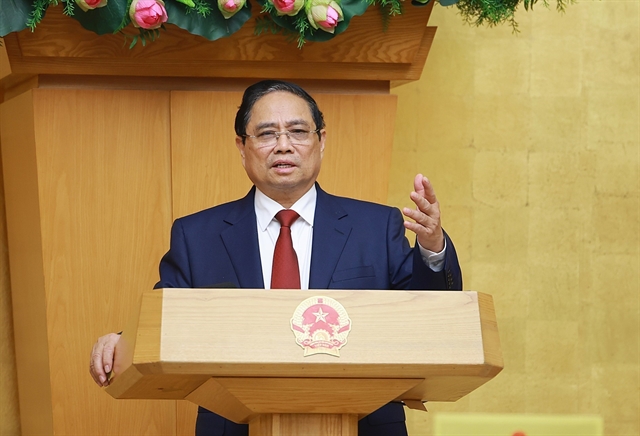
| Prime Minister Phạm Minh Chính. — VNA/VNS Photo Dương Giang |
HÀ NỘI — Prime Minister Phạm Minh Chính has written an article reviewing the 2021-2026 term and outlining expectations for the new tenure.
The Vietnam News Agency (VNA) respectfully introduces a translation of the article.
Accelerating Breakthroughs, Determined to Successfully Realise Resolution of the 14th National Party Congress
by Prime Minister Phạm Minh Chính
The 14th National Party Congress was a resounding success, carrying with it new aspirations and confidence, creating a new momentum and opening up new impetus for the country’s development. With a spirit of unity, profound innovation, decisive action, and the highest political determination, we will certainly overcome all difficulties and challenges, leverage the strength of national unity combined with the strength of the times, realise the two strategic centenary goals, and lead the country steadily into a new era – an era of thriving development, prosperity, civilisation, and happiness, steadily advancing towards socialism.
Looking back at the 2021-2025 term, the entire Party, people, and army have demonstrated unwavering resilience, overcoming “storms,” seizing every opportunity, and striving tirelessly to achieve very important results in the cause of national construction and defence. In the context of a rapidly changing and complex world, with many unprecedented and unpredictable issues, fierce strategic competition, conflicts occurring in many places, especially the COVID-19 pandemic, natural disasters, floods, and climate change causing very serious consequences; under the leadership of the Party Central Committee, and directly and regularly by the Politburo and the Secretariat, headed by the General Secretary (formerly comrade Nguyễn Phú Trọng and currently comrade Tô Lâm); the Government, the Prime Minister, and administrations at all levels, sectors, and localities have made extraordinary efforts, closely adhering to reality, focusing on leading and directing the decisive, flexible, and effective implementation of Resolutions and Conclusions of the Party Central Committee, the Politburo, the Secretariat, and the National Assembly.
With the motto “The Party has directed, the Government has agreed, the National Assembly has concurred, the people have supported, the nation has expectations, and international friends have provided assistance, so we will only discuss and act, not retreat,” and “what is said must be done, what is committed must be implemented; what is done and implemented must be effective,” we have “turned crisis into opportunity,” “turned the situation around, transformed the state,” and achieved many important, comprehensive, and all-encompassing achievements in various fields, most notably: successfully controlling the COVID-19 pandemic with the spirit of “Putting the health and lives of the people above all else,” while simultaneously promoting socio-economic recovery and development.
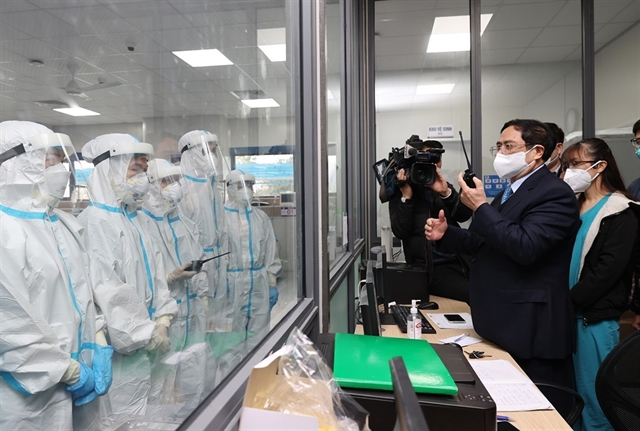 |
| Prime Minister Phạm Minh Chính visits medical workers attending to COVID-19 patients in Hà Nội in January 2022. — VNA/VNS Photo Dương Giang |
The economy has demonstrated remarkable resilience, achieving one of the highest growth rates in the region and the world while maintaining macroeconomic stability, effectively controlling inflation, and ensuring major economic balances; public debt, government debt, and budget deficits have been below the prescribed limits. Strategic breakthroughs have been implemented decisively and effectively, contributing to the creation and opening of new development spaces towards “open institutions, seamless infrastructure, and smart governance.” The development of science and technology, innovation, and national digital transformation has been vigorously pursued. Many long-standing issues have been addressed, contributing to combating waste and unleashing resources for development.
The cultural and social sectors have made progress in terms of awareness, action, and results. Social welfare policies, care for war veterans, and poverty reduction have been comprehensively and effectively implemented, achieving many outstanding results with the spirit of “leaving no one behind”; the poverty rate has decreased to about 1.3 per cent; and the material and spiritual lives of the people have continued to improve.
The revolution to reorganise the country, streamline the political system and the two-tiered local administration apparatus, coupled with the acceleration of administrative procedure reform, decentralisation, and delegation of power, has been implemented decisively and effectively, as General Secretary Tô Lâm affirmed: “The decision to ‘reorganise the country’ is a historical step of strategic significance, marking a new stage of development in the process of perfecting the state administrative apparatus.”
Inspection, auditing, and the fight against corruption, wastefulness and misconduct have been intensified. National defence and security potential and strategic autonomy have been consolidated and strengthened; the largest ever investment in national defence and security has been prioritised. Political and social stability has been maintained; and security and order have been upheld. Foreign affairs and international integration have been a highlight with many important accomplishments; Việt Nam’s position and prestige in the international arena have been enhanced; and a peaceful and stable environment for national development has been preserved.
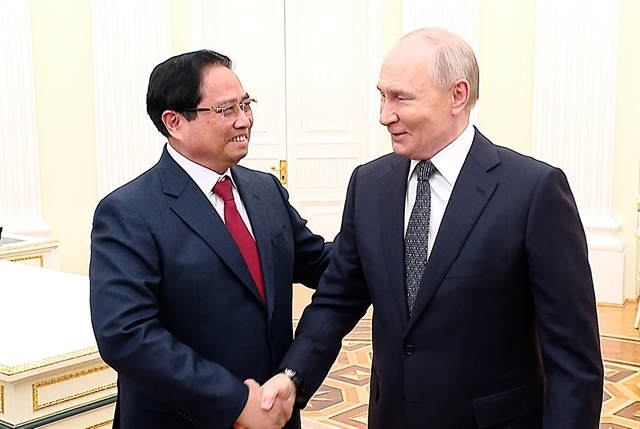 |
| Prime Minister Phạm Minh Chính meets Russian President Vladimir Putin during his most recent foreign visit to Moscow in March 2026. — VNA/VNS Photo Dương Giang |
From practical experience in leadership, guidance, and administration, we can draw five valuable lessons for the next stage of the country’s development: First, the correct and wise leadership of the Party is the primary factor determining all victories of the Vietnamese revolution; implementing the Party and State’s guidelines, policies, and strategies decisively, proactively, flexibly, and creatively; grasping the situation and responding with timely, appropriate, and effective policies, especially to new, difficult, and unprecedented issues.
Second, it is necessary to continuously consolidate and strengthen unity, promote the strength of unity within the Party, the people, the nation, unity from top to bottom, and international solidarity, while simultaneously demonstrating high determination, great effort, and decisive action.
Third, the people make history; strength originates from the people. Human beings are at the centre, as the subject, the goal, and the most important resource and driving force for development, building the people’s firm trust in the leadership of the Party and the State.
Fourth, it is a must to combine national strength with the strength of the times; internal strength is fundamental, strategic, long-term, and decisive; external strength is important, necessary, and groundbreaking; we must look far ahead, think deeply, and act on a grand scale; we value time, intellect, and timely decisiveness.
Fifth, it needs to promote decentralisation and delegation of power coupled with resource allocation, improve implementation capacity, strengthen inspection, supervision, and control of power; assign tasks according to the spirit of “six clear points: clear person, clear task, clear responsibility, clear authority, clear time, clear results.”
Overall, in the context of difficulties and challenges outweighing opportunities and advantages, especially the “double impact” of adverse external factors and long-standing internal limitations and shortcomings, the achievements of the 2021-2025 period are very important and worthy of respect and pride, highly appreciated by the people and the international community. In particular, we have maintained “internal stability and external peace,” consolidating and strengthening the people’s firm trust in the Party and the State; continuing to create a trend of innovation; creating momentum for rapid and sustainable development; creating a force for inclusive and comprehensive development; creating a new impetus to lead the country steadily into a new era.
Entering 2026, the first year of the 2026-2030 term, with special significance, is a period of national transformation, entering a new era of development amidst the predicted rapid, complex, and unpredictable changes in the global situation and landscape. The trends of fragmentation, separation, and multipolarity are changing, and even disrupting, many rules that have shaped the world order for decades; strategic competition among major powers continues to intensify and become increasingly complex; global supply chains, trade, and investment are experiencing significant fluctuations; the explosive development of new technologies is having a profound impact on many aspects; non-traditional security factors, epidemics, natural disasters, and climate change continue to occur unpredictably, causing severe consequences; while Việt Nam remains a developing country, its economy is in transition, its scale is still modest, its openness is high, and its competitiveness and resilience need to be further strengthened.
In particular, since the end of February 2026, military conflicts have erupted and spread in the Middle East, severely impacting many countries, regions, and the global economy. However, this must also be seen as an opportunity to restructure the economy towards a green, digital, rapid, and sustainable direction.
The 14th National Party Congress set the goals and requirements for the 2026-2030 term as maintaining a peaceful and stable environment, developing the country rapidly and sustainably, and firmly protecting the socialist Vietnamese homeland; striving for double-digit economic growth; continuously improving and comprehensively enhancing the people’s lives; strategic autonomy, self-reliance, self-confidence, and strong progress in the new era of the nation; successfully achieving the two 100-year strategic goals, for a peaceful, independent, democratic, prosperous, civilised, happy Việt Nam, steadily advancing towards socialism.
The guiding principle is to steadfastly and creatively apply Marxism-Leninism, Hồ Chí Minh Thought, and the Party’s theory of reform; steadfastly pursue the goal of national independence linked with socialism; maintain strategic autonomy while continuously innovating mindset, models, and development methods to drive rapid and sustainable national development with the motto: development for stability, stability for development; strongly awaken the tradition of patriotism, the aspiration for development, the spirit of solidarity, the will for self-reliance, self-confidence, self-strength, and national pride; promote the strength of culture and human resources as endogenous resources and powerful driving forces for development.
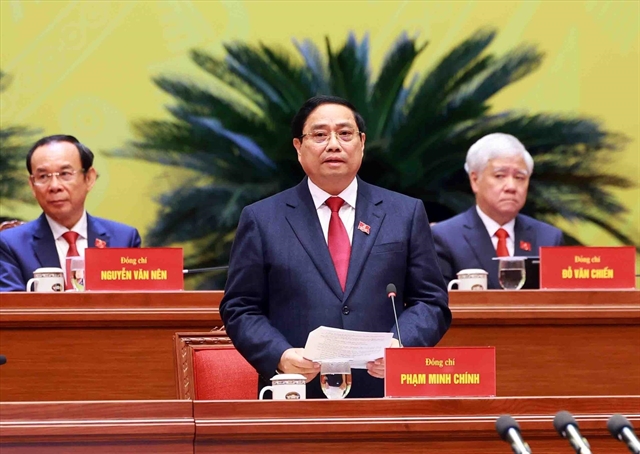 |
| Prime Minister Phạm Minh Chính speaks at the 14th National Party Congress of the Communist Party of Việt Nam in January 2026. — VNA/VNS Photo |
It is necessary to accelerate the construction and comprehensive improvement of institutions for rapid and sustainable development; ensure strategic autonomy in conjunction with the simultaneous implementation of the four transformations: digital transformation, green transition, energy transformation, and the transformation of the structure and quality of human resources. It is a must to implement key tasks in a coordinated manner, with economic and social development and environmental protection as the central focus; Party building as the key element; cultural and human development as the foundation; and strengthening national defence and security and promoting foreign affairs and international integration as crucial and regular priorities.
At the recent second meeting of the 14th Party Central Committee, Party General Secretary Tô Lâm summarised and underscored five key tasks for the tenure, namely: (1) political and ideological work within the Party with the “four steadfast principles”; (2) double-digit economic growth target; (3) bringing into play the strengths of the two-tier local administration model; (4) inspection, supervision, power control, and the fight against corruption, wastefulness and other negative phenomena; and (5) ensuring national defence, security, foreign affairs, and international integration in the new period. Among these, double-digit economic growth is an objective requirement stemming from the country’s development requirements in the new stage and the entire nation’s aspiration to rise, anchored in four core principles.
At the same time, to create a “driver of drivers” for development, the Party Central Committee will soon formulate a Resolution on the national development model in the new period, based on science and technology, innovation, and digital transformation. In the era of innovation, it is imperative to change mindset and shift from a passive, reactive stance to proactive adaptation, turning challenges into opportunities and transforming effective risk control into a competitive advantage for the economy.
Ministries, sectors and localities are required to urgently grasp and implement these orientations; focus on clearly identifying groundbreaking drivers, put forward concrete solutions across sectors, and assign responsibilities in line with the spirit of “six clarities” to achieve double-digit growth; stay close to realities and be well prepared with plans and scenarios for direction and administration; prioritise groundbreaking solutions capable of “turning the tide and shifting the state” to seize opportunities and promote sectoral development; while enhancing strategic forecasting capacity, strategic autonomy, and risk governance; and concentrating on removing bottlenecks, promoting production and business activities, reducing costs, and facilitating people and enterprises.
The country is entering a new era, with the tasks ahead being heavy, yet also highly honourable and a responsibility before history for our generation today. Grasping the spirit that “resources stem from mindset and vision; momentum stems from innovation and creativity; strength stems from the people and enterprises,” under the leadership of the Party and the Government, administrations at all levels, sectors, and localities must act with greater determination and creativity in leadership, direction, and administration, generating breakthroughs in development with the guiding principle that “having made efforts, greater efforts must follow; having shown determination, stronger determination must be demonstrated; having acted resolutely, even more resolute action is required,” and that “what is said must be done; what is committed must be delivered; what is implemented must be effective.”
It is necessary to focus on the serious, resolute, synchronised, and effective implementation of the Resolutions of the Party, the National Assembly, and the Government; with an emphasis on “one goal, two assurances, three contributions, four no’s, and five transformations”: (i) “one goal” is to ensure that the people enjoy a prosperous and happy life, with each year better than the last; (ii) “two assurances” include ensuring development to maintain stability, and ensuring stability to promote rapid and sustainable development; (iii) “three contributions” include contributions from the State, from enterprises, and from the people; (iv) “four no’s” include no wasting of a single day, no delay of a single week, no missed opportunity in a month, and no passivity throughout the year; (v) “five transformations” include greening; digitalisation; optimising distinct potential, outstanding opportunities, and competitive advantages; intelligentising governance and administration; and harmonising the interests of the State, the people, and enterprises. In this regard, particular attention should be paid to the following key priorities:
Thoroughly grasping, comprehensively internalising, and resolutely, synchronously, and effectively implementing the Resolution of the 14th National Party Congress is the central political task of the entire Party, people, and armed forces for the 2026–2030 tenure. On the basis of this Resolution and the Politburo’s groundbreaking resolutions in key sectors, the Government, administrations at all levels, sectors, and localities must promptly translate them into action programmes and implementation plans with clear, feasible roadmaps, objectives, tasks, and solutions, with defined priorities and focal points, and with specific outcomes that are measurable, quantifiable, and verifiable.
Priority should be given to upholding the responsibility of heads of agencies and units in organising implementation, inspection, supervision, and evaluation of results based on concrete deliverables; addressing formalism and the “achievement disease”; strongly promoting the spirit of innovation, daring to think big, act bold and act till completion, and daring to take responsibility for the common good; thereby creating clear and tangible changes in both awareness and action across the entire political system, among the people, and the business community from the very outset of the tenure.
It is essential to unlock, mobilise, and effectively utilise all resources, fully promote creativity, a sense of responsibility, and the highest levels of effort and determination, with a new mindset, new approaches, and groundbreaking solutions to achieve the target of double-digit growth. Practical experiences from the region and the world show that countries seeking to overcome the middle-income trap and rise to high-income status have all undergone periods of rapid economic growth at double-digit rates, coupled with accelerated industrialisation and modernisation, strong investment in education and training, science and technology, strategic infrastructure, and deep integration into global value chains.
For our country, this is a strategic objective that must be attained, yet it is also highly challenging, requiring both the full revitalisation and renewal of traditional growth drivers such as investment, consumption, and exports, and the vigorous promotion of new growth drivers, in which science and technology, innovation, digital transformation, and green transition serve as the foundation and play a leading role. At the same time, it is necessary to focus on effectively harnessing new development spaces following the reorganisation of administrative units, streamlining the organisational apparatus, and implementing the two-tier local administration model. In particular, high growth must go hand in hand with maintaining macroeconomic stability, controlling inflation, and ensuring major economic balances, thereby creating a solid foundation for rapid and sustainable national development in the new era.
In the context of a world situation that is forecast to remain complicated and unpredictable, it is necessary to continue closely monitoring and firmly grasping developments, strengthening analytical and forecasting capacity, and proactively adopting solutions to “turn the tide and shift the state,” ensuring timely, flexible, and effective responses across all sectors, while minimising negative external impacts. At the same time, it is essential to consolidate and enhance the country’s strategic autonomy and consistently implement the policy of building an independent and self-reliant economy associated with proactive, active, deep, substantive, and effective international integration.
Attention should be paid to continuing to pursue a reasonably expansionary fiscal policy in a focused and targeted manner; ensure close, harmonious coordination with proactive, flexible, timely, and effective monetary policy so as to both maintain macroeconomic stability, control inflation in line with set targets, and contribute to removing difficulties for production and business, supporting enterprise development and promoting growth. It is imperative to accelerate the disbursement of public investment; use public investment to lead and catalyse private investment in strategic infrastructure, energy transition, logistics, digital infrastructure; and rationally utilise fiscal space in public debt and state budget deficits to mobilise additional resources for development investment.
At the same time, it is necessary to promote and unlock private investment flows and both indirect and direct foreign investments into priority sectors and fields, thereby enhancing the economy’s productive capacity. In mobilising resources through public–private partnerships, emphasis must be placed on consistently and effectively implementing the principle of “harmonising benefits and sharing risks.” More attention should also be paid to synchronously implementing solutions to expand markets, stimulate consumption, and support production and business in a manner appropriate to conditions, especially for small- and medium-sized enterprises; making the domestic market a solid pillar of the economy; emphasising diversification of markets, products, and supply chains; responding promptly, flexibly, and effectively to external fluctuations; and ensuring the achievement of export and import growth targets.
It is essential to focus on resolutely and effectively implementing strategic breakthroughs to create fundamental improvements in growth quality, and enhance efficiency, competitiveness, and the resilience of the economy. First, development institutions are the “breakthrough of breakthroughs”; institutions must go ahead, pave the way, and become a national competitive advantage in the spirit of “a facilitating State, pioneering enterprises, public–private partnership, national development, people’s well-being”; resolutely eliminate the “ask–give” mechanism and the mindset of “if it cannot be managed, then ban it”; focus on completing and improving the quality of the institutional and legal system to ensure it is comprehensive, synchronised, modern, internationally integrated, relatively stable, and predictable, serving both state management requirements and development promotion, with development facilitation at the core; improve the quality and efficiency of markets in mobilising, allocating, and utilising resources, especially the large volumes of idle capital in the economy; promote the in-depth development of financial markets associated with upgrading the stock market, developing the corporate bond market, the gold market, and the real estate market in a transparent and healthy manner, while preventing and effectively managing systemic risks; accelerate the operation of the international financial centre and the development of free trade zones and new business models.
Second, there is a need to focus on economic restructuring and improving the quality of human resources, thereby enhancing labour productivity, efficiency, competitiveness, and rapid, sustainable development; prioritise the completion and effective implementation of policies to attract and utilise talents; promote high-quality workforce and vocational training in key and strategic sectors and occupations, ensuring alignment with labour market requirements in the context of economic restructuring and international integration; step up foreign language education, making English a second language in schools; promote integrated education approaches (STEM, STEAM), scientific research, digital skills development, artificial intelligence (AI) capabilities, and global citizen education; and develop groundbreaking scientific research programmes and projects, with focusing on 11 groups of strategic technologies, shifting decisively from “application” to “mastery” and “self-reliance” associated with technological convergence capacity.
Third, it is imperative to prioritise the development of a comprehensive, modern, smart infrastructure system with strong spillover effects, capable of attracting investment resources from across society, especially for strategic and key infrastructure projects; focus on developing high-quality, multimodal transport infrastructure, ensuring seamless connectivity among regions and localities, and synchronised connections with the region and the world; prioritise the development of green energy infrastructure, digital infrastructure, modern data centres, urban infrastructure, and disaster prevention and climate change adaptation infrastructure. Extra efforts must be made to complete over 5,000km of expressways and the Lào Cai–Hà Nội–Hải Phòng railway before 2030; further accelerate the progress of the Hà Nội–Lạng Sơn railway; urgently commence investment in the North–South high-speed railway; and soon start construction of nuclear power plant projects with a 100-year vision, thereby ensuring energy security for rapid and sustainable development.
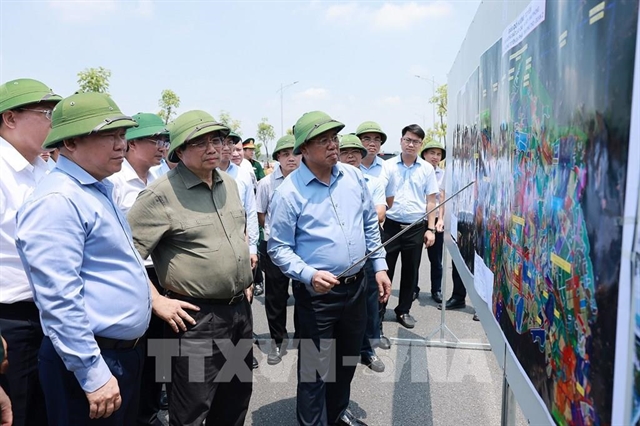 |
| Prime Minister Phạm Minh Chính visits the project site of the Lào Cai–Hà Nội–Hải Phòng railway in Phú Thọ Province in August 2025. — VNA/VNS Photo Dương Giang |
Due attention should be paid to promoting a strong transformation of the growth model based on science and technology, innovation, digital transformation, and green transition; developing new productive forces; enhancing national scientific, technological, and innovation capacity to reach advanced levels in key fields so as to place the country among the leading group of upper-middle-income economies; accelerating industrialisation and modernisation; and vigorously promoting economic restructuring both across sectors and within sectors.
Emphasis should also be placed on improving the efficiency and competitiveness of foundational and supporting industries; prioritising the development of several leading technology enterprises; gradually mastering production technologies in emerging sectors such as semiconductor chips, robotics, automation, AI, advanced materials, biotechnology, environment, renewable energy, and new energy; improving the quality, efficiency, and competitiveness of service sectors; building high-quality service and tourism centres, making tourism truly a spearhead economic sector; and strongly developing the international financial centre, new-generation free trade zones, and major logistics hubs associated with international airports, transshipment seaports, and major international border gates.
It is necessary to promote the restructuring of agriculture and rural economies towards high-quality development; advance green, ecological, and circular transformation along value chains with efficiency; prioritise the development of large-scale commodity production areas with high added value and deep-processing centres for agriculture, forestry, and fisheries in the direction of “green agriculture – clean products – high technology – sustainable markets.” Promoting regional economic development and inter-regional connectivity, bringing into full play the role of key economic regions, growth poles, economic corridors, and major economic centres; prioritising the development of the marine economy in tandem with safeguarding national sovereignty over the country’s sea and islands; and developing effectively new economic models such as the low-altitude economy, data economy, silver economy, circular economy, sharing economy, and night-time economy are essential.
There is also a need to strengthen linkages among the State, private, and foreign-invested economic sectors; adopt appropriate policies to encourage household businesses to transform into enterprises; strongly develop large economic groups and Vietnamese enterprises with strong brands and international credibility, thus enabling deeper participation in regional and global value chains; and prioritise the attraction of new-generation, effective, and selective FDI associated with technology transfer.
It is necessary to place particular emphasis on developing the cultural and social sectors, ensuring social progress and equity, social security, and improving the living standards of the people. It is essential to closely and harmoniously link, and ensure, the development of culture and society on a par with economic development, so that all citizens may benefit from the fruits of the process of renewal and national development; develop culture so that it truly becomes a foundation, an endogenous strength, and a driving force for rapid and sustainable development; build an advanced Vietnamese culture imbued with national identity, unified in diversity; effectively implement the Politburo’s Resolution No 80-NQ/TW on the development of Vietnamese culture; give due attention to the internationalisation of national cultural identity and the nationalisation of the quintessence of world culture; strongly develop cultural industries, the entertainment industry, and the creative economy; encourage the development of institutional systems and the organisation of cultural activities in a practical and effective manner, taking grassroots areas and the people as the centre, narrowing the gap in access to and enjoyment of culture among regions and population groups.
It is a must to construct a number of major cultural and sporting works of regional and international levels; establish mechanisms to encourage public–private partnership, and build and creatively develop effective models and institutions for culture, sport, and cultural management. It is imperative to fully and promptly implement policies for those who have rendered meritorious service, policy beneficiaries, and vulnerable groups, ensure social security and sustainable poverty reduction in the spirit of not sacrificing social progress, equity, and social security in pursuit of mere economic growth, “leaving no one behind”. It is essential to promptly adopt solutions to respond to and mitigate the adverse impacts of unusual external fluctuations, natural disasters and epidemics on production, business, employment, livelihoods, and the lives of the people.
There is a need to strengthen the protection, care, and improvement of public health in accordance with Resolution No 72-NQ/TW of the Politburo; bring into full play the advantages of the golden population period. It is a must to closely coordinate and effectively implement national target programmes on new-style rural development, sustainable poverty reduction, socio-economic development in ethnic minority and mountainous areas, education and training, healthcare, and culture, especially at the grassroots level. We must strive to soon complete the construction of one million social housing units and inter-level high schools in 248 land border communes. We should also effectively implement policies on ethnicity, religion, the elderly, gender equality, for the advancement of women, children, and youths; pay attention to ensuring hygiene and safety in schools and hospitals; and improve Việt Nam’s international rankings in the human development index and the happiness index.
It is essential to further enhance environmental protection, disaster prevention and control, and adaptation to climate change. It is a must to enhance the efficiency of the management, exploitation, and use of land, natural resources, and important minerals, especially forest, marine, water, and rare earth resources; implement resolutely and synchronously solutions for environmental protection in both urban and rural areas, prevent the decline of biodiversity, and protect and restore ecosystems; fundamentally remedy serious environmental pollution in major cities, craft villages, and river systems; strive for the proportion of days in a year with air quality index (AQI) at good and moderate levels in special urban areas to reach 75-80 per cent; accelerate green transition, reduce greenhouse gas emissions, and move towards the goal of net-zero emissions by 2050.
There is a need to focus on effectively implementing programmes and projects on disaster prevention and control and climate change adaptation, especially sea-level rise, landslides, saltwater intrusion, and freshwater shortages in the Mekong Delta; flood and landslide prevention in midland and mountainous areas; and flood mitigation in major urban areas. It is imperative to enhance the capacity for forecasting and warning of natural disasters; proactively relocate, resettle and ensure stable livelihoods, employment, and income for people in high-risk disaster areas. The overarching spirit is to restructure the economy so as to adapt effectively to climate change.
It is a must to promote administrative reform and the prevention and combat of corruption, wastefulness and misconduct, thereby contributing to consolidating and strengthening the confidence of the people and society as a whole. It is essential to focus on building a service-oriented, professional, modern, and transparent administration with the motto “streamlined apparatus – connected data – smart governance”, shift decisively from an administrative management mindset to a development governance approach, placing people and enterprises at the centre and taking public satisfaction as the measure of results.
There is a need to strongly improve the investment and business environment and enhance competitiveness; continue to review, cut, simplify 100 per cent of unnecessary, inconsistent, overlapping, unclear business conditions; reduce by 50 per cent the time and cost of compliance with administrative procedures. It is imperative to promote decentralisation and delegation of authority, bringing into play the autonomy and accountability of localities in association with resource allocation and strengthened inspection and supervision, in line with the principle “localities decide, localities implement, localities take responsibility”; improve the quality and effectiveness of the operation of two-tier local administration.
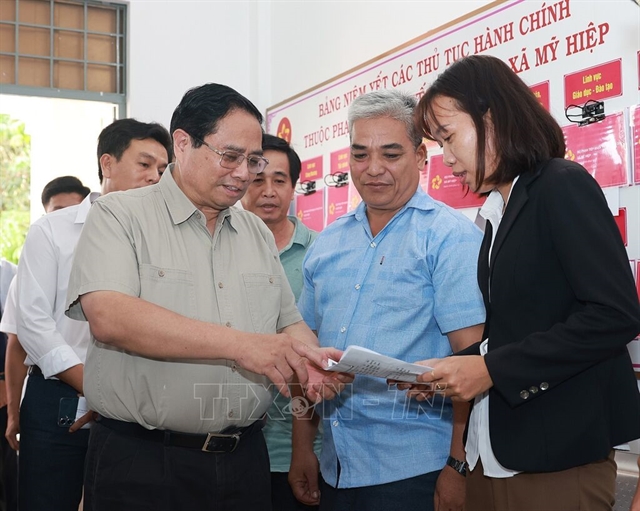 |
| Prime Minister Phạm Minh Chính visit the public service centre of Mỹ Hiệp Commune, Đồng Tháp Province in mid-July 2025 following the transition to a two-tier local administration. |
It is a must to modernise and enhance national management and governance capacity on the basis of digital databases, build a digital government, digital economy, and digital society, particularly national and specialised databases in accordance with the principles of “accurate, sufficient, clean, live, unified, and shared”; build a modern, effective, and efficient system of national governance; create a healthy, open, transparent, and stable investment and business environment with reduced compliance costs, consistent with good international practices; encourage innovation, creativity, unleash productive forces, mobilise all resources, and create new drivers for development.
It is necessary to resolutely prevent and combat corruption, wastefulness and misconduct; closely combine proactive prevention with active detection and the strict and timely handling of violations, with no forbidden areas and no exceptions; at the same time, ensure appropriate salary and remuneration regimes, timely rewards, and strict discipline. We should continue to review, clearly and specifically stipulate mechanisms and policies to encourage and protect officials who are dynamic and creative, dare to think, dare to act, and dare to take responsibility for the common good; build a disciplined and orderly society that lives and works in accordance with the Constitution and the law, and launch movements to practise thrift and combat wastefulness throughout society.
There is a need to consolidate and strengthen defence and security potential, promote foreign affairs and international integration, and maintain a peaceful and stable environment for rapid and sustainable national development. It is imperative to continue to focus on building and consolidating the all-people national defence, the all-people national defence posture, and the people’s security, in conjunction with building the people-based posture and firm, proactive defensive zones. It is necessary to adhere steadfastly to the “four no’s” defence policy; build revolutionary, regular, elite, and modern people’s army and people’s public security forces; enhance the combat strength of the people’s armed forces and firmly safeguard the Fatherland in all situations. It is a must to strongly develop self-reliant, independent, self-sufficient, dual-use, and modern defence and security industries; maintain political security and social order and safety; firmly safeguard national security, human security, economic security, and cyber security; respond promptly and effectively to both traditional and non-traditional security challenges.
We should persist in and remain steadfast to a foreign policy of independence, self-reliance, diversification and multilateralisation, being a good friend, a reliable partner, and a responsible member of the international community; foster foreign affairs in the new era commensurate with the country’s historical stature, cultural identity, and potential and position; proactively and actively pursue deep, substantive, and effective international integration; fully bring into play the country’s potential, advantages, and new stature and strength; promote economic diplomacy, technology diplomacy, and energy diplomacy; proactively, actively, and readily contribute to international efforts to address global issues and challenges, including conflicts and hotspots, in the spirit of “solidarity creates strength, cooperation creates benefits, dialogue strengthens trust”; continue to promote the pioneering role of foreign affairs, closely coordinating with defence and security to proactively prevent the risks of war and conflict, maintain a peaceful, stable, cooperative, and development-oriented environment, and contribute to enhancing the country’s prestige and standing in the region and the world.
It is necessary to strengthen and improve the effectiveness of information and communication work, creating a high level of unity in awareness, will, and action across the entire Party, people, and army in implementing and widely disseminating the spirit of the Resolution of the 14th National Party Congress. It is essential to promote policy communication, ensuring that every major guideline and important decision of the Party and the State is fully, promptly, clearly, and accessibly communicated, enabling the people to clearly understand objectives, content, and implementation roadmaps so as to accompany, supervise, and actively implement them. We should pay attention to identifying and widely disseminating exemplary models, good practices, effective initiatives, and good people and good deeds, creating positive spillover effects in the spirit of “using the good to eliminate the bad, using the positive to repel the negative”, thereby contributing to consolidating and strengthening public trust.
There is a need to resolutely struggle against and refute wrongful and hostile viewpoints, false, malicious, and harmful information that causes confusion and incites public opinion; closely link information and communication work with building and strengthening the great national unity bloc, arousing patriotism, national pride, aspirations for development, the will for self-reliance and self-strengthening, and civic responsibility, bring into full play the combined strength of the entire political system, the active participation of the people and the business community in overcoming all difficulties and challenges, thereby contributing to the successful realisation of the set socio-economic development goals.
Each decision taken today not only addresses immediate issues but also shapes the country’s position and future for decades to come. Looking back over the past five-year journey, despite facing unprecedented “headwinds”, with a spirit for the people and the nation, steadfastness in our policy, and mettle and decisiveness in direction and administration, we have remained calm and confident, “turning danger into opportunity”, “turning nothing into something, turning difficulty into ease, turning the impossible into the possible”, transforming challenges into driving forces, achieving important, comprehensive, and commendable accomplishments of which we may be justly proud, leaving a profound mark on the course of national development.
Entering the next five-year term, although the global context remains complicated and unpredictable, with the position and strength accumulated over 40 years of Đổi Mới (Renewal), with the mettle, intellect, and development aspirations of the entire nation; with the resolute engagement of the entire political system and the unity, solidarity, and concerted efforts of compatriots and soldiers nationwide under the leadership of the Party, directly and regularly that of the Party Central Committee’s Politburo and Secretariat, headed by General Secretary Tô Lâm, we shall certainly overcome all difficulties and challenges, successfully implement the Resolution of the 14th National Party Congress, achieve the two strategic centenary goals, with the overarching viewpoint of double-digit growth associated with growth quality and sustainable development, and realise the aspiration to build a strong and prosperous country standing shoulder to shoulder with the great powers of the five continents, as our beloved President Hồ Chí Minh always wished. — VNA/VNS
Nguồn: https://vietnamnews.vn/politics-laws/1778828/pm-pham-minh-chinh-reviews-past-term-outlines-expectations-for-new-tenure.html