


 |
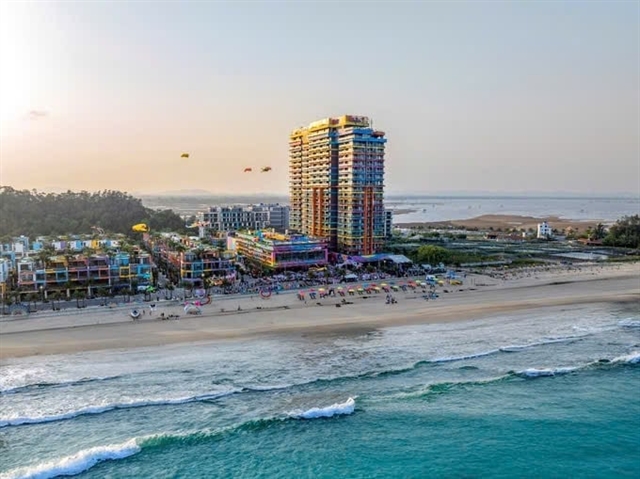
| The coastal real estate market is a motivation for growth. — Photo nongnghiepmoitruong.vn |
HÀ NỘI — Amid climate change and growing pressure on land-based resources, a sea-oriented vision is no longer an option but inevitable. Marine space has become a domain that multiple economic sectors can exploit, utilise and develop sustainably.
The Ministry of Agriculture and Environment has recently proposed major orientations for sea and island management including strengthening the management and use of marine space; enhancing integrated management of resources and protection of the coastal environment; controlling marine and island environmental pollution; promoting science, technology and digital transformation; and supplementing mechanisms for the sustainable development of the marine economy.
From an ‘ask–grant’ approach to a market mechanism
According to Nguyễn Thanh Tùng, deputy general director of the Việt Nam Agency of Seas and Islands, the most significant initiative is the completion of the institutional framework for managing and using marine space, an area that has long had legal gaps.
Notably, it introduces economic instruments such as auctions for sea area use rights, resource valuation, registration and certification of sea area use rights.
“This marks an important step towards allocating resources based on market mechanisms instead of the previous administrative approach,” Tùng told nongnghiepmoitruong.vn.
“As multiple sectors, such as offshore wind power, aquaculture, tourism and maritime transport, compete for marine space, conflicts of interest are increasing.
“Establishing inter-sectoral coordination mechanisms, zoning and multi-purpose management is therefore essential.”
If clearly designed and effectively implemented, this will represent a fundamental shift from a ‘ask–grant’ system to a transparent, predictable, market-based allocation of marine resources, Tùng added.
Digitalised marine governance
Application of science, technology and digital transformation in managing marine resources and the environment is also a new aspect.
Building a synchronised, interconnected database on marine resources and environment across ministries, sectors and localities has been identified as a key task.
Data will not only support management but also become a ‘production asset’ for policymaking, forecasting and decision-making.
New regulations aim to promote the application of technology in monitoring, supervision and forecasting marine environments; developing marine spatial information systems; and integrating multi-sectoral data. This forms the basis for moving from manual to smart management.
It is necessary to expand mechanisms to mobilise private sector participation in scientific research, baseline surveys and marine technology development – areas that have long relied mainly on state budgets.
Public–private partnerships will help enhance national capacity and gradually achieve technological autonomy.
With standardised, connected and effectively shared data, marine governance can shift from reactive to proactive, and from fragmented to integrated.
Decentralisation
Vũ Duy Kiên, an expert from the Ministry of Home Affairs, said that it was needed to supplement more specific regulations on marine economic development, including tourism and services to fisheries.
This would provide a basis for ensuring the comprehensiveness of the policy and facilitate effective implementation by localities.
Kiên emphasised the need to strengthen decentralisation and delegation of power to local governments.
“Localities needed to be given more autonomy in managing, exploiting, and protecting marine resources, along with specific responsibilities,” Kiên said.
“However, implementation must be based on the existing apparatus, avoiding the creation of additional personnel, in line with the policy of streamlining the political system.”
From a local perspective, Nguyễn Đức Cường, deputy director of the Department of Agriculture and Environment of Thanh Hoá Province, said that it was necessary to develop flexible mechanisms and policies that are appropriate to the natural, economic, and social conditions of each coastal locality.
“Applying a rigid policy framework would make it difficult to fully realise the potential of each region,” Cường said.
“Therefore, it needed to create a sufficiently broad ‘policy space’ for localities to proactively apply.”
Sharing the same view, Nguyễn Tiến Hùng, deputy director of the Department of Agriculture and Environment of Hà Tĩnh Province, suggested that regulations on granting the right to use sea areas need to be clarified further, especially in the context of increasing conflicts of interest between businesses and coastal communities.
He also pointed out the challenges in assessing the environmental impact of offshore renewable energy projects, as well as the difficulties in managing coastal protection corridors.
“Issues related to administrative decentralisation and overlapping in maritime channel planning need to be reviewed and addressed comprehensively,” Hùng said.
For real estate to break through
Along with the management of natural resources and the sea and island environment, the coastal real estate market is seen as having strong opportunities for expansion, forming new development models linked to the marine economy.
Experts said that if well oriented and supervised, the coastal real estate is not only motivation for growth but also contributes to sustainable exploitation of natural resources and tourism.
Dr Nguyễn Văn Đính, vice president of the Việt Nam Real Estate Association, said that the boom in coastal real estate over the past decade has contributed to changing the face of many localities, transforming pristine coastlines into vibrant tourist and resort centres.
However, while contributing positively to the growth of tourism, services, and infrastructure, the ‘overheated’ development of the coastal real estate segment also poses numerous challenges regarding the environment, climate change adaptation, and sustainable development requirements.
Vũ Anh Tú, an expert from the Ministry of Construction, said: “Planning and management still face limitations such as overlapping use of marine space; inconsistent implementation across localities; lack of long-term monitoring mechanisms; and insufficient integration of environmental, social, and governance (ESG) criteria.”
To ensure the proper, sustainable, and effective development of coastal real estate, experts emphasises the crucial role of planning.
First and foremost, they said, it is necessary to approach coastal space in an integrated manner, considering it as part of the national master plan, with clear functional zoning for development objectives: economic, conservation, national defence and security.
As institutions, planning, and infrastructure are gradually improved, coastal real estate will not only be an attractive investment sector but also a crucial pillar in Việt Nam’s sustainable marine economic development strategy in the future. — VNS
Nguồn: https://vietnamnews.vn/society/1778561/changes-in-marine-governance-help-push-economic-growth.html