


 |
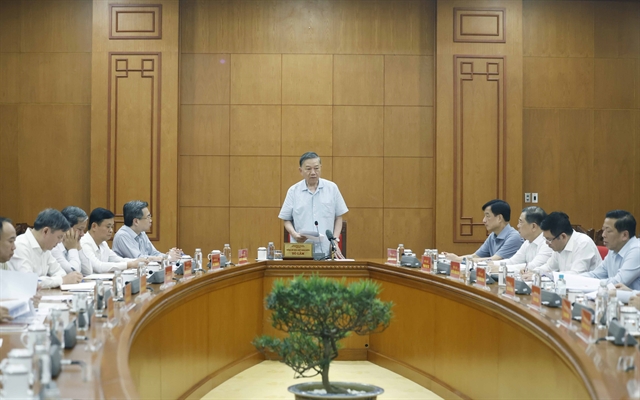
| Party General Secretary and President Tô Lâm on May 21 chaired ameeting with the Party Central Committee’s Commission for Policies and Strategies on orientations for developing Việt Nam’s materials industry. — VNA/VNS Photo |
HÀ NỘI — Việt Nam must develop its materials industry in a green, sustainable and self-reliant direction with international competitiveness, in line with global commitments, while ensuring the highest national interests, General Secretary of the Communist Party of Việt Nam Central Committee and State President Tô Lâm said at a working session in Hà Nội on Thursday.
Speaking at a meeting with the Party Central Committee’s Commission for Policies and Strategies and representatives from relevant ministries and agencies on orientations for developing Việt Nam’s materials industry, the top leader stressed that the country has natural resources and market demand. Its greatest shortcomings lie in core technologies, deep processing capabilities, leading enterprises, an integrated ecosystem for research, testing, certification and commercialisation, as well as a sufficiently robust strategy to organise a national materials value chain.
He underscored the need to identify the materials industry as a foundational and strategic sector in the country’s industrialisation and modernisation process. Development, he said, should be focused and prioritised rather than spread thinly, with the industry organised into three tiers: foundational materials to be maintained and upgraded; strategic materials requiring breakthroughs; and future materials to be prepared from an early stage.
General Secretary and President Lâm also called for a strong shift from raw resource extraction towards deep processing, technological mastery and higher domestic added value, with science and technology, standards, high-quality human resources and Vietnamese enterprises serving as the key pillars of development.
He assigned the Government’s Party Committee to lead the drafting of a strategy for the development of Việt Nam’s materials industry to 2030 with a vision to 2045, urging its issuance at the earliest possible date.
According to the leader, the strategy must closely follow the Party’s major orientations on industrialisation and modernisation, science and technology, innovation, digital transformation, green transition, private economic sector development, energy security, national defence, security and international integration.
The General Secretary and President pointed to five priority areas in the immediate future: rare earth materials, semiconductor materials, materials for batteries and energy storage, new materials, and next-generation construction materials. These sectors, he noted, are fundamental to industrialisation, modernisation and economic self-reliance, and therefore require careful assessment within the strategy to determine the appropriate priorities, roadmap and support mechanisms.
He also highlighted the need to upgrade traditional material industries in a greener and more technology-driven direction with greater added value; make breakthroughs in science and technology, standards, testing and high-quality human resources; foster the development of Vietnamese enterprises; and build a domestic market for new, green and strategic materials, while improving institutions, strengthening inter-sectoral coordination, enhancing inspection and supervision, and safeguarding national interests in international integration.
Participants at the meeting noted that Việt Nam’s materials industry has recorded important progress in recent years. Sectors such as steel, cement, construction materials, basic chemicals, fertilisers, plastics, rubber, textiles and industrial wood processing have developed rapidly.
Việt Nam also possesses significant reserves of rare earths, bauxite, titanium, tungsten, graphite, silica sand and limestone. Meanwhile, emerging fields including new, green and recycled materials, semiconductors, electronics, batteries, renewable energy, biomedical materials and composites have begun to attract growing attention.
While production volumes are high, the industry remains weak in high-quality products. Despite abundant resources, deep processing remains limited. Some large-scale industries continue to generate high emissions and consume large amounts of energy and natural resources.
Although foreign direct investment (FDI) has increased, linkages with domestic enterprises remain modest, and commercialisation has been slow. Many critical materials, meanwhile, still depend heavily on imports. — VNA/VNS
Nguồn: https://vietnamnews.vn/politics-laws/1781863/top-leader-calls-for-development-of-green-sustainable-self-reliant-materials-industry.html