


 |
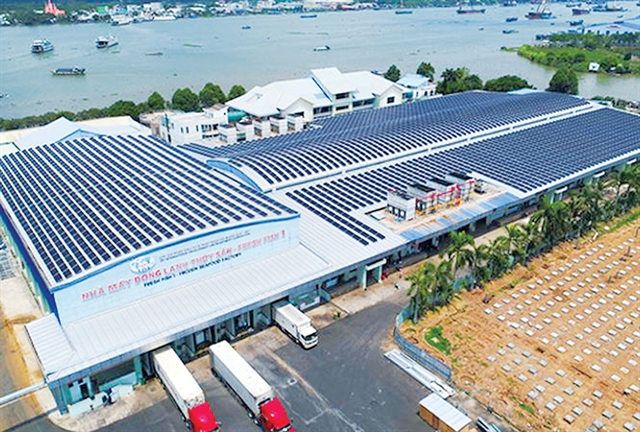
| Solar panels installed on the roof of a seafood processing factory in the Mekong Delta. — Photo evn.vn |
HÀ NỘI — Amid increasingly unpredictable global energy prices, intensifying extreme weather and mounting pressure to reduce emissions, Việt Nam’s industrial parks are facing the challenge of securing sufficient electricity for production while also controlling costs and moving toward energy independence.
Rooftop solar power, especially when combined with Battery Energy Storage Systems (BESS), is emerging as a strategic solution, paving the way for a greener, more flexible and more sustainable industrial park model.
According to energy experts, businesses can save between 20 and 40 per cent on electricity costs by adopting rooftop solar power systems, with an average payback period of around four to six years, while system lifespans can extend from 25 to 30 years.
This helps stabilise long-term production costs amid fluctuating electricity prices. Practical implementation in several major industrial parks has already demonstrated clear benefits.
A rooftop solar power system with a total capacity of approximately 90MWp has been in operation at Thăng Long Industrial Park in Hà Nội since 2021, helping many businesses reduce electricity costs while also meeting increasingly stringent sustainability and emissions reduction standards required by international partners.
Assistant general director of Thăng Long Industrial Park Lisa Iguchi said the deployment stemmed from the practical needs of factories, especially in the electronics sector, as well as environmental responsibility and sustainable development requirements.
“The use of renewable energy not only delivers economic benefits, but also enhances competitiveness within the global supply chain,” she said.
Similarly, at Amata Industrial Park in Đồng Nai Province, the ecological industrial park model associated with renewable energy is also being strongly promoted. Many FDI enterprises in the park have invested in rooftop solar systems to meet increasingly strict ESG standards.
Rooftop solar power has a major advantage because its highest electricity output occurs during the daytime, exactly when industrial park production loads peak.
This synchronisation allows businesses to significantly reduce the amount of electricity purchased from the grid, especially during peak hours.
However, Dr Nguyễn Huy Hoạch from the scientific council of Vietnam Energy Magazine told the Hà Nội Mới newspaper that solar power still has an inherent limitation due to its intermittent generation pattern.
This means its economic efficiency cannot be fully maximised without complementary solutions, according to Hoạch.
For this reason, BESS is increasingly seen as the missing piece needed to complete the energy independence equation.
When combined with rooftop solar systems, BESS allows excess daytime electricity to be stored and used during periods with higher electricity prices, helping businesses reduce costs and optimise energy use.
BESS also helps shave peak loads, reducing pressure on the national grid and ensuring stable operations for industries that require uninterrupted power supply.
More broadly, the integration of rooftop solar and BESS is gradually creating a distributed energy ecosystem within industrial parks, with the national grid serving as a flexible backup source when needed.
At a more advanced stage, industrial parks could even evolve toward microgrid models, enabling flexible operations, real-time cost optimisation and greater resilience against energy disruptions.
However, practical implementation still faces many challenges. Investment costs for energy storage systems remain high, while electricity pricing mechanisms and regulations regarding self-generated and self-consumed electricity are still being refined.
In addition, grid infrastructure and green financing models have yet to develop in line with market demand.
According to experts, for this model to achieve its full potential, Việt Nam needs to quickly finalise time-of-use electricity pricing mechanisms, creating sufficient price differences between time periods to encourage investment in energy storage.
At the same time, it is necessary to promote a competitive electricity market, develop smart grid infrastructure and diversify financial tools to support businesses in their green transition. — VNS
Nguồn: https://vietnamnews.vn/economy/1781976/rooftop-solar-emerges-as-key-tool-to-reduce-energy-costs-in-industrial-parks.html